
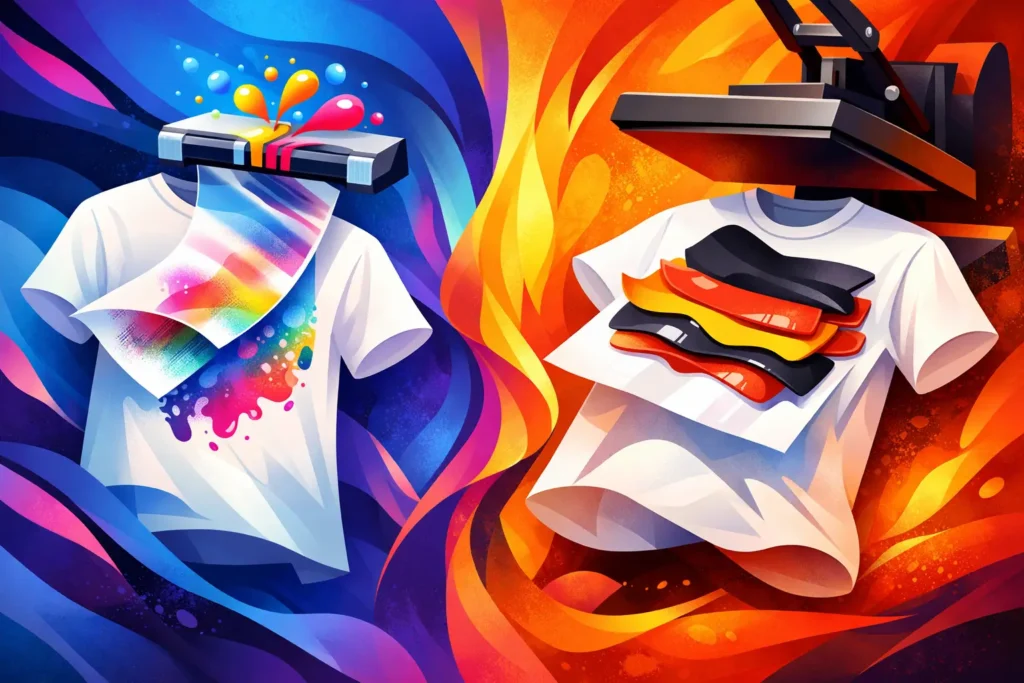
A customer needs 24 full-color staff shirts for a restaurant opening this weekend. Another needs 300 one-color tees for a school fundraiser next month. They may both want a great print, but they should not automatically get the same decoration method. The DTF versus plastisol transfers decision comes down to your artwork, garment mix, order size, timeline, and the finish you want people to feel when they wear the shirt.
Both options can produce professional custom apparel. Both can be heat applied. Both can work for brands, teams, events, uniforms, and resale. The difference is how they get there – and choosing the right one can save time, reduce waste, and give your order a better final result.
DTF Versus Plastisol Transfers at a Glance
DTF, or direct-to-film, transfers are printed digitally in full color on a special film, coated with adhesive powder, cured, and then heat pressed onto the garment. The process handles detailed artwork, gradients, photographs, and multiple colors without screen setup or vinyl weeding.
Plastisol transfers use screen-printing inks that are printed onto release paper, gelled or cured, then heat pressed onto apparel. They are especially strong for simple, bold graphics that repeat across larger orders. A plastisol transfer can deliver the familiar look and feel associated with traditional screen printing, particularly when the art is designed for it.
Neither method is automatically better. DTF is often the faster, more flexible answer for colorful designs and mixed garment orders. Plastisol can be a smart production choice when the design is simple, the quantities are high, and the artwork will be used repeatedly.
| Factor | DTF Transfers | Plastisol Transfers | |—|—|—| | Best for | Full-color, detailed, short-run, and mixed orders | Bold spot-color designs and repeat bulk runs | | Setup | Minimal digital setup | Screen setup is usually required | | Color capability | Full color, gradients, photos, fine detail | Best with defined spot colors | | Garment flexibility | Works on cotton, polyester, blends, and more | Works well on many fabrics, depending on ink system | | Feel | Smooth, flexible printed layer | Can range from soft to thicker, based on ink and art | | Turnaround | Often very fast | Can take longer when screens must be prepared |
When DTF Transfers Make More Sense
DTF is built for the kind of jobs that used to create production headaches: a small run with a colorful logo, individual names and numbers, a photo memorial shirt, or a business design with shading and tiny text. Because the artwork is printed digitally, there is no separate screen needed for every color. That keeps setup simple and makes low-quantity orders much more practical.
For a birthday shirt, family reunion, memorial item, or last-minute event order, DTF gives you the freedom to use the actual artwork you want instead of simplifying it to fit a screen-print process. Bright colors, gradients, illustrated characters, and detailed logos can all stay intact. White ink also helps artwork remain visible on dark garments.
DTF is also a strong choice when an order includes different garment colors, sizes, or fabric types. A landscaper may need safety-yellow shirts, black hoodies, and gray work polos. A sports program may need cotton tees for volunteers and performance polyester for players. With the right production settings, DTF allows one full-color design to move across those garments without rebuilding the job for each colorway.
Speed is another major advantage. At GFX The Print Shop, DTF is a practical solution for customers who need professional full-color transfers without waiting through a traditional screen setup process. That matters when your event date is fixed and your order cannot slip.
The Trade-Off With DTF
DTF is not invisible ink. On large solid designs, you will feel a printed layer on the shirt. Modern transfers can be soft and flexible when produced and pressed correctly, but a large full-front image will usually feel more noticeable than a light water-based screen print.
Artwork also matters. Fine details reproduce well, but low-resolution files still look low resolution. A blurry social-media screenshot will not become a crisp logo just because it is printed with DTF. For the best result, provide clean, high-resolution artwork with transparent backgrounds when possible.
When Plastisol Transfers Are the Better Fit
Plastisol transfers deserve a close look when your artwork is straightforward and your order is built around repetition. Think one- or two-color team logos, bold chest prints, contractor uniforms, event tees, and designs that will be reordered throughout the year.
If a construction company needs the same two-color logo applied to hundreds of black shirts over several production runs, plastisol may be efficient. Once the screens and art are established, the transfer can be produced consistently for repeat use. This is especially useful for decorators or businesses that want to keep approved artwork ready for future orders.
Plastisol can also offer different finish options. Depending on the ink, mesh, underbase, and artwork, a print can have a bold athletic look, a smooth solid appearance, or special effects such as puff or metallic finishes. It is a familiar option for classic logo-driven apparel where spot colors are part of the brand identity.
The Trade-Off With Plastisol
The setup is where plastisol becomes less convenient for many customers. Each color generally requires its own screen, so a design with six colors is more involved than a one-color logo. For a dozen shirts with a full-color image, the setup time and cost may not make sense.
Plastisol also does not naturally handle photographic detail and smooth color gradients the way DTF does. Those effects can be simulated with halftones and advanced screen-printing techniques, but that requires more planning and production work. For a quick, full-color order, DTF is usually the more direct path.
Color, Detail, and Artwork: Choose for the Design
Start with the art, not the method. If your design includes a photo, complex illustration, multiple colors, fading tones, or small detailed elements, DTF is usually the clear choice. It is made for reproducing digital artwork with strong color impact.
If your design is a clean one-color logo or a few solid brand colors, plastisol can be an excellent fit. It is especially appealing when the art will run again and again. A simple design does not need a complicated production method just to look professional.
There are exceptions. A simple logo can still be a great DTF job when you only need a few shirts, want same-day service, or need to press that logo on multiple garment types. Meanwhile, a full-color design can sometimes be screen printed using specialty separations for a large enough run. The right answer depends on the complete job, not just one feature.
Durability Is About More Than the Transfer Type
Customers often ask which option lasts longer. The honest answer is that both DTF and plastisol transfers can be durable when they are produced correctly, pressed at the right temperature and pressure, and cared for properly.
A quality DTF transfer should stretch with the garment and hold up through repeated washes. A quality plastisol transfer can also remain vibrant and resilient for a long time. Premature cracking, peeling, or fading is often tied to poor artwork preparation, incorrect pressing, low-grade materials, or harsh laundering rather than the basic transfer category alone.
For either option, wash garments inside out in cold water, use mild detergent, avoid bleach when possible, and dry on low heat or hang dry. Do not iron directly on the printed area. These simple habits help preserve color and flexibility.
Cost and Turnaround: Where the Decision Gets Real
For small orders, DTF frequently offers better value because there is no screen setup charge for each color. You can order one shirt, 10 shirts, or a gang sheet filled with different graphics without paying for a separate screen every time. That makes it ideal for startup brands testing designs, event organizers with changing names, and customers ordering personalized apparel.
For larger runs of simple artwork, plastisol can become more cost-effective. The upfront setup has a purpose: it supports efficient repeat production. If you are ordering hundreds of the same one-color or two-color design, ask for a quote based on the full quantity and your reorder plans.
Turnaround should be discussed early. If your shirts are needed tomorrow, a transfer method with less setup can be the difference between having apparel at your event and having it after the event. Share your deadline, garment type, print locations, and artwork before production starts. A good print partner can then recommend the process that matches the job instead of forcing every order into one method.
Make the Choice Based on the Job in Front of You
Choose DTF when you need full color, sharp detail, flexible quantities, quick production, or prints across different apparel types. Choose plastisol when you have bold spot-color artwork, a larger repeat order, and a production plan that benefits from screen-based consistency.
The best custom shirt is not the one made with the trendiest method. It is the one that arrives on time, looks right from across the room, feels appropriate on the garment, and keeps representing your event or business after the first wash.